

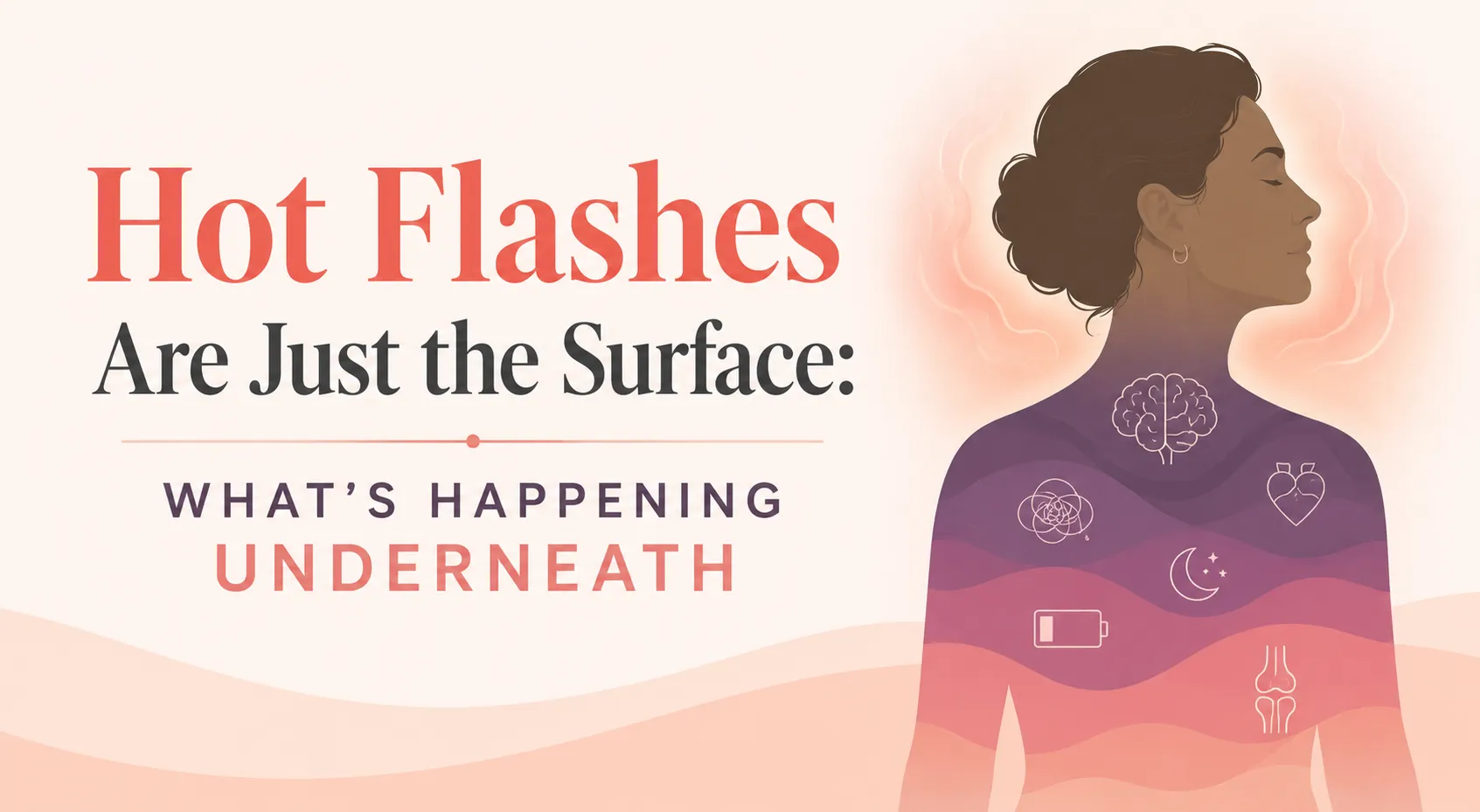
The hot flash is the face of menopause. It’s what everyone pictures: the sudden wave of heat, the flush, the sweat. When women talk about menopause at the doctor’s office, that’s usually what the conversation centers on.
But for most women, the hot flashes are the most visible part of a much larger shift happening across their entire endocrine system. Some of the more impactful changes are happening quietly, without a visible symptom to announce them, until they’ve accumulated into something harder to address.
Understanding what’s actually happening underneath gives women a more complete picture of why early intervention matters, and why treating only the hot flashes leaves most of the story untold.
What a Hot Flash Actually Is
A hot flash is a thermoregulatory event. The hypothalamus, the brain region that controls body temperature, becomes more sensitive to small temperature fluctuations as estrogen declines. The result is an exaggerated response to what would normally be a minor thermal signal. Blood vessels dilate rapidly. Heat is pushed to the skin’s surface. Sweat follows.
The hypothalamus contains estrogen receptors. When estrogen levels are stable, those receptors help regulate the temperature response within normal limits. When estrogen fluctuates or drops, the thermostat becomes unstable.
This is important to understand because it means the hot flash isn’t the problem. It’s a symptom of the problem. The problem is declining estrogen and the instability that fluctuation creates across multiple body systems that rely on estrogen signaling.
The Night Sweat Underneath the Hot Flash
Night sweats are hot flashes during sleep. They’re worth treating as their own issue because of what they do to sleep.
When a woman is waking multiple times a night in a sweat, changing clothes or sheets, she’s not completing sleep cycles. She’s not reaching the deep restorative stages that allow the brain to consolidate memory, clear metabolic waste, and restore cognitive function. She’s not getting the cortisol regulation that healthy sleep provides.
After six months of broken sleep, she’s running a significant cortisol deficit and a significant sleep debt. Those compound. Elevated cortisol from chronic sleep deprivation drives fat storage around the midsection, increases inflammation, and contributes to insulin resistance. The hot flashes are visible. Their downstream consequences on metabolism, cognition, and adrenal health are not.
The Quiet Changes No One Talks About
Hot flashes and night sweats are the symptoms most women know to watch for. The following are just as common. They just get less airtime.
Joint pain. Estrogen has a lubricating effect on connective tissue. The same way estrogen decline produces dry skin, dry hair, and vaginal dryness, it also affects joint lubrication. Many women attribute worsening joint stiffness or achiness in the hands, knees, and hips to aging or physical wear. In many cases, it’s estrogen deficiency.
Cognitive changes. Brain fog, word-finding difficulties, and reduced concentration during perimenopause are tied to estrogen’s role in cerebral blood flow and neurotransmitter function. These symptoms often start before hot flashes appear and can persist long after.
Vaginal dryness and urogenital atrophy. The tissue of the vaginal walls and urinary tract is highly estrogen-responsive. As estrogen drops, these tissues become thinner, drier, and less resilient. This affects sexual comfort, can increase urinary frequency, and is associated with recurrent urinary tract infections. Women often don’t mention this in medical visits because they’ve been led to expect it as inevitable.
Anxiety. The decline of progesterone, which converts to a calming neurosteroid, removes a natural buffer for the nervous system. The adrenal stress response, already running high from poor sleep, operates without that buffer. Women who have never had significant anxiety find it appearing in their 40s and can’t identify why.
Depression or emotional flatness. Estrogen influences serotonin and dopamine systems. Declining estrogen doesn’t cause clinical depression in every woman, but it changes the baseline mood environment. For women who are already carrying significant stress, the estrogen shift can push mood below the threshold of what they can manage with their usual coping strategies.
The Estrogen-Gut Connection
Estrogen doesn’t disappear cleanly when the body is done with it. It goes through a multistep metabolic process that involves the liver and the gut microbiome.
A subset of gut bacteria called the estrobolome controls the final step of estrogen elimination. These bacteria produce an enzyme that conjugates estrogen for excretion. When the estrobolome is imbalanced, this process breaks down. Instead of being eliminated, estrogen is reactivated and recirculated. The result is more estrogen exposure than the body needs, driving symptoms like breast tenderness, heavy periods, and bloating that look like estrogen excess even when a woman is perimenopausal.
This is why gut health is part of the hormonal conversation. The hot flash comes from too little estrogen. The bloating and breast tenderness can come from impaired elimination. Addressing the hormonal picture without addressing the gut only solves part of the problem.
The Bone Density Story
This one is genuinely urgent and almost completely invisible until it isn’t.
Bone mineral density depends on estrogen. Estrogen inhibits the activity of osteoclasts, the cells that break down bone. When estrogen drops sharply at menopause, osteoclast activity accelerates. Women can lose between one and two percent of bone density per year in the years immediately following menopause if estrogen isn’t supported.
This decline doesn’t hurt. There’s no symptom. Women find out about it when they get a bone density scan, often years after the loss has accumulated, or in the worst cases, after a fracture. A woman who breaks her hip at 68 may have spent the previous decade thinking she was healthy because she had no symptoms.
Maintaining estrogen levels during and after the menopause transition, when started early in the transition, significantly slows this bone loss. It’s one of the strongest preventive arguments for early hormonal intervention.
The Cardiovascular Picture
Estrogen also plays a protective role in cardiovascular health. It supports flexible, healthy endothelial function (the inner lining of blood vessels), helps maintain favorable cholesterol ratios, and supports blood pressure regulation.
The cardiovascular risk profile for women shifts noticeably in the years after menopause. Before menopause, women have lower rates of cardiovascular disease than age-matched comparison groups. After menopause, that advantage erodes.
Early hormone replacement therapy, started during the perimenopausal transition, is associated with cardiovascular benefit. Late initiation, years after menopause, does not carry the same profile and may carry risk. The window matters. Getting there early, before cardiovascular protection is lost, makes the intervention more beneficial.
The Hormonal Triangle Underneath All of It
Every system described above is connected to every other. The thyroid, adrenals, and ovaries function as an integrated unit. Estrogen decline from the ovaries affects thyroid binding. Cortisol elevation from sleep disruption suppresses thyroid output and interferes with sex hormone signaling. DHEA depletion from chronic adrenal stress reduces the precursor material for both estrogen and testosterone.
Treating hot flashes as an isolated symptom, the way conventional medicine tends to approach them, provides some relief but doesn’t address the system. A woman who gets a progesterone cream for night sweats and nothing else for the bone density loss, the joint changes, the cognitive shifts, and the cardiovascular risk is receiving partial care.
Comprehensive hormonal support, with careful testing, individualized dosing, and ongoing monitoring, addresses the whole picture. The hot flash is the signal that something broader is happening. Following that signal into the full picture is what actually changes long-term outcomes.
About the Author: Dr. Sasha Rose is a naturopathic physician and licensed acupuncturist at Med Matrix, a functional medicine clinic in South Portland, Maine. She specializes in women’s hormone health, bioidentical hormone therapy, and root-cause approaches to perimenopause and menopause.